How to Remove a Coffee Stain From Carpet
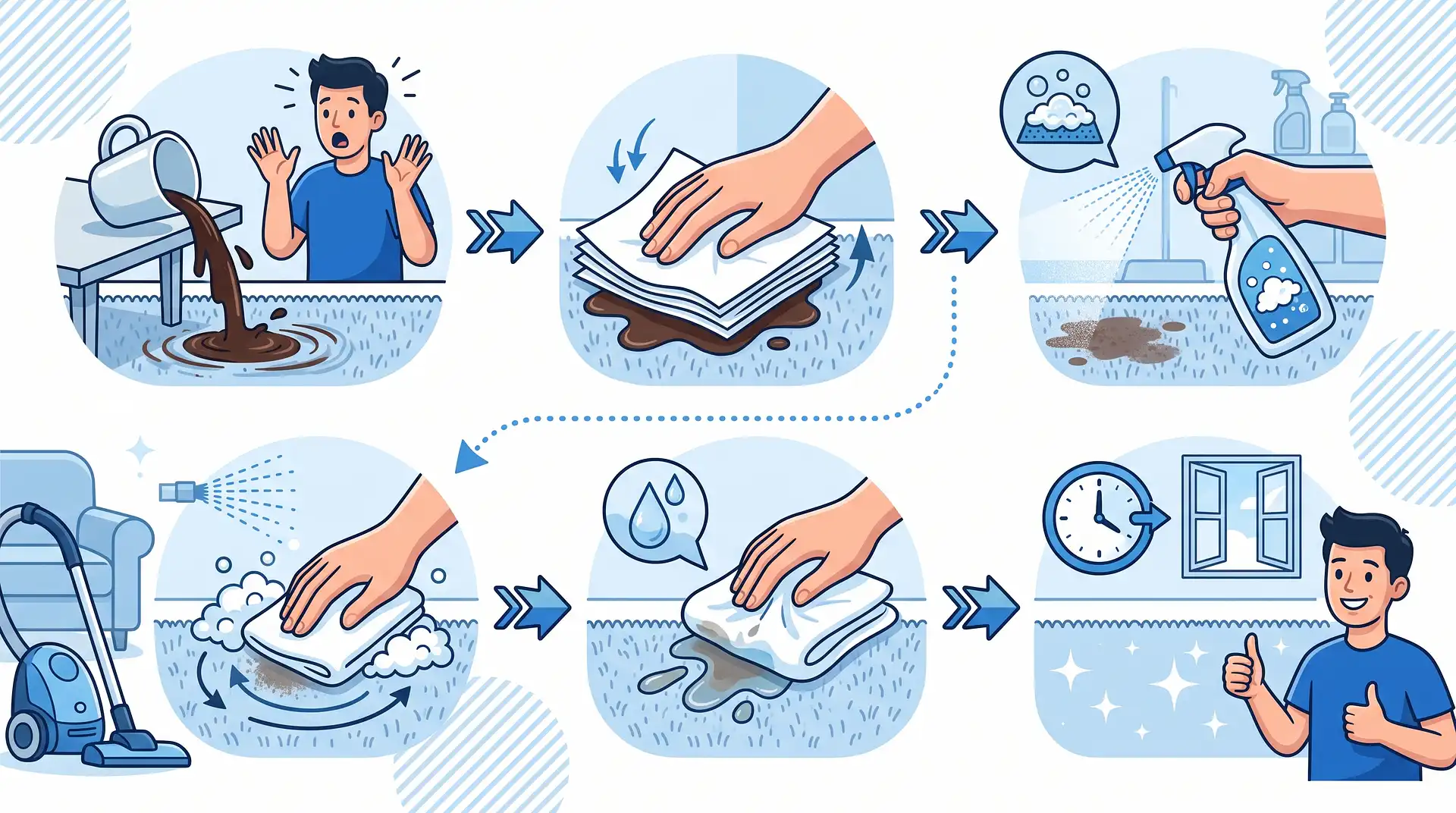
If you have just spilt coffee, do three things before you read any further. Grab a white towel or a thick wad of kitchen roll. Press it firmly into the spill without rubbing. Keep swapping to a dry section until nothing more transfers. Then flush the area with a little cool water and blot again. Those first ninety seconds decide most of the outcome.
Now that the worst is contained, here is the part almost nobody tells you. The stain in front of you is not one problem. It is two or three. Coffee contains tannins, which behave much like a fabric dye. If you took milk, there is protein in there as well. If you took sugar, there is a sticky residue that will keep pulling dirt into that exact spot for months. Each of those needs handling differently, and the fibre under your feet decides how forgiving the job is going to be.
This guide covers fresh spills, dried stains that have been sitting for weeks, and the frustrating situation where a stain you had successfully removed comes back the next morning. It also covers the safety side properly, because most online stain guides cheerfully tell you to mix chemicals and soak your flooring without mentioning a single risk.
Before you start: safety first
None of this is dramatic, but it is worth two minutes of your time. Carpet cleaning at home involves chemicals, water and electricity in the same room, and that combination catches people out.
Never mix cleaning products. This is the important one. Household bleach mixed with anything acidic, including white vinegar or limescale remover, releases chlorine gas. Bleach mixed with ammonia based cleaners, which includes many glass cleaners, produces chloramine vapour. Both are genuinely dangerous in an enclosed room. Bleach has no place on carpet anyway, but the general rule holds: one product at a time, rinsed out before you try anything else.
Read the label. UK household cleaning products carry CLP hazard pictograms, the orange and white diamonds, along with hazard and precautionary statements. If a product shows a corrosive or health hazard symbol, take the stated precautions seriously. Ignore social media recipes that tell you to combine several products for extra strength.
Ventilate the room. Open a window before you start and leave it open while the carpet dries. This is not just about fumes. A damp patch of carpet and underlay in a closed up British home, particularly through autumn and winter with the heating on, is exactly how you end up with a musty smell and mould growth in the underlay.
Wear gloves. Even mild detergents strip skin oils, and vinegar stings anything you have already scratched. Rubber or nitrile gloves are enough. If you are using anything with a health hazard pictogram, eye protection is sensible.
Watch the slip hazard. A damp carpet is slippery, and a damp stair carpet is dangerous. If the spill is on stairs, keep everyone off them until the area is properly dry and use the handrail. Never leave wet cleaning cloths on a stair tread. If you are cleaning in a workplace or a communal area, put out a wet floor sign. The Health and Safety Executive treats slips and trips as one of the most common causes of workplace injury in the UK, and a wet carpet in an office corridor is a foreseeable risk.
Keep water away from electrics. Do not spray cleaning solution near floor level sockets, extension leads or trailing cables. Move them out of the way first. If you are using any mains powered equipment such as a wet vacuum or a fan on damp flooring, plug it through an RCD protected socket. Most modern UK consumer units provide RCD protection, but older properties may not, in which case use a plug in RCD adaptor.
Children and pets stay off until dry. Keep them out of the room while you are applying anything, and off the area until it has dried fully. Store every product out of reach, in its original labelled container, with the cap on. Never decant cleaning solution into a drinks bottle. That mistake causes real harm every year.
A note for offices and commercial premises. If you are cleaning in a workplace rather than your own home, the Control of Substances Hazardous to Health Regulations apply to the products you use. That means holding safety data sheets, assessing the risks and making sure whoever does the work is trained and equipped. In practice, most businesses are better off using a contractor who already has that documentation in place.
Work out what your carpet is made of
This is the step every online guide skips, and it decides whether coffee lifts out easily or bonds permanently.
<table style="min-width: 100px;"><colgroup><col style="min-width: 25px;"><col style="min-width: 25px;"><col style="min-width: 25px;"><col style="min-width: 25px;"></colgroup><tbody><tr><th colspan="1" rowspan="1"><p>Fibre</p></th><th colspan="1" rowspan="1"><p>Common in UK homes</p></th><th colspan="1" rowspan="1"><p>How it handles coffee</p></th><th colspan="1" rowspan="1"><p>Main risk</p></th></tr><tr><td colspan="1" rowspan="1"><p>Polypropylene (olefin)</p></td><td colspan="1" rowspan="1"><p>Very common in modern budget and mid range fitted carpets, bedrooms, rentals</p></td><td colspan="1" rowspan="1"><p>Excellent. Solution dyed and essentially non absorbent to water based dyes. Coffee usually comes out completely, even after weeks</p></td><td colspan="1" rowspan="1"><p>Holds greasy soil badly. Melts under heat and friction</p></td></tr><tr><td colspan="1" rowspan="1"><p>Wool or 80/20 wool rich</p></td><td colspan="1" rowspan="1"><p>Traditional Axminster and Wilton, quality fitted carpet, older properties</p></td><td colspan="1" rowspan="1"><p>Poor to moderate. Wool is a protein fibre with a natural affinity for tannins. Speed works strongly in your favour</p></td><td colspan="1" rowspan="1"><p>Alkaline cleaners, bleach, peroxide and over wetting all cause real damage</p></td></tr><tr><td colspan="1" rowspan="1"><p>Nylon or polyamide</p></td><td colspan="1" rowspan="1"><p>Common on stair runners and in heavy traffic areas</p></td><td colspan="1" rowspan="1"><p>Moderate. Nylon accepts acid dyes readily, so hot coffee can genuinely dye it. Responds well to correct spotting</p></td><td colspan="1" rowspan="1"><p>Heat sets the stain permanently</p></td></tr><tr><td colspan="1" rowspan="1"><p>Polyester and PET</p></td><td colspan="1" rowspan="1"><p>Increasingly common in soft touch carpets</p></td><td colspan="1" rowspan="1"><p>Good against water based stains</p></td><td colspan="1" rowspan="1"><p>Attracts oily soil. Pile flattens</p></td></tr></tbody></table>Not sure which you have? Check the label on an offcut if the carpet was fitted recently, or look for a manufacturer's tag inside a wardrobe or under a radiator. Failing that, use the water absorption test. Put a single drop of cool water on a hidden section of pile, inside a wardrobe or behind a door, and watch it. On polypropylene the drop sits on the surface and beads for a noticeable time. On wool it soaks in fairly quickly and the fibre darkens. It is not laboratory grade, but it tells you which route to take.
If you genuinely cannot tell, treat the carpet as wool. The wool method is the cautious one and it will not harm a synthetic.
One rule regardless of fibre: no heat. Not hot water, not a hairdryer, not a steam mop, not an iron. Heat drives tannin into the fibre and sets it. Cool or barely lukewarm only.
What you need
Nothing exotic, and nothing that means a trip to the shops at eight in the evening.
-
Several white cotton towels, or a full roll of plain kitchen roll. Coloured cloths can transfer their own dye into damp carpet
-
A spray bottle or a jug of cool water
-
Clear, uncoloured washing up liquid. A quarter of a teaspoon, no more
-
White vinegar
-
A soft brush or a white cloth for gentle agitation
-
Rubber or nitrile gloves
-
Something heavy and waterproof for the drying stage. A stack of books inside a carrier bag works fine
If you already own a dedicated carpet spotter from a reputable brand, use that instead of the homemade mix. It will be pH controlled and formulated to rinse clean, which is exactly where homemade solutions struggle.
Removing a fresh coffee stain, step by step
Step 1: Absorb, do not spread
Press a folded white towel firmly onto the spill and hold it for a few seconds. Lift, refold to a dry section, repeat. Work from the outer edge inwards so you are not pushing the spill wider than it already is.
Do not rub or scrub. Scrubbing does two things you cannot undo. It drives liquid deeper towards the backing and underlay, and it distorts the pile. On wool in particular, aggressive rubbing fibrillates the fibre and leaves a permanently fuzzy patch that catches the light differently from everything around it. Far more carpets are ruined by panicked scrubbing than by the original spill.
Step 2: Dilute with cool water
Lightly mist or pour a small amount of cool water onto the stain. Enough to dampen it, not to soak it. Blot again. Repeat two or three times. You are diluting the tannin before it has time to bond.
Keep an eye on the towel. When it stops picking up brown, plain water has given you everything it is going to give.
Step 3: Mix and test your solution
Mix a quarter of a teaspoon of clear washing up liquid into 500ml of cool water, then add a tablespoon of white vinegar. That is the whole recipe. Resist the urge to make it stronger. Detergent strength is not what removes the stain, and excess detergent is the single most common cause of a stain appearing to come back.
Before it goes anywhere near the visible stain, test it. Dab a little onto a hidden section of the same carpet, inside a wardrobe, under a sofa or behind a door, then press a white cloth onto it. If any carpet colour transfers to the cloth, stop there. Your carpet is not colour fast, and a DIY attempt will lift the dye along with the coffee. That situation needs a professional with the right neutralising products.
Do the test in daylight if you can. Colour change is very easy to miss under a warm bulb.
Step 4: Apply, leave it, blot
Apply the solution to a cloth rather than pouring it onto the carpet, then dab it into the stain. Leave it for three to five minutes. Dwell time does the work, because the chemistry needs contact time to break the tannin's grip on the fibre.
Then blot with a clean dry towel. Reapply and repeat as many times as it takes. Slow and repeated always beats strong and fast on carpet.
If the coffee had milk in it and a faint mark or a slight smell lingers, an enzyme based cleaner will deal with the protein in a way that detergent will not. Follow the product's own dwell time, which is usually longer than people expect, and keep the room ventilated while it works.
Step 5: Rinse properly, because this is the step people skip
Mist the area with clean cool water and blot it out. Do this at least twice.
Every trace of detergent you leave behind stays slightly tacky. It attracts soil from shoes and socks and turns into a grey brown patch within weeks. Homeowners then assume the coffee stain returned. It did not. A new dirt stain formed in exactly the place the residue was sitting.
Step 6: Dry it under weight
Fold a thick dry towel over the damp area, put something heavy on top, and leave it for several hours. As the carpet dries, moisture travels upward and carries any remaining coffee with it. The towel intercepts it instead of letting it redeposit at the tips of the pile.
Keep the room ventilated and put a fan on the area on a cool setting if you have one. Never use a heater or a hairdryer to speed it up, both because heat sets tannin and because leaving a heat source running on damp flooring is a fire risk.
Aim to have the area properly dry within a few hours. If a carpet stays damp for more than a day, particularly on a suspended timber floor where moisture has nowhere to escape, you are risking odour and mould in the underlay rather than solving a stain.
Once dry, vacuum the area and groom the pile back in line with the carpet around it.
Removing an old, dried coffee stain
Dried stains are harder but often far from hopeless, particularly on polypropylene. The difference is that you are rehydrating a bonded stain rather than lifting a loose one.
-
Vacuum first. Dried coffee leaves a crust, and any milk or sugar residue will have gathered fine grit around it.
-
Rehydrate. Mist with cool water and leave it for ten minutes. Do not soak it. A damp stain is workable, a saturated one creates new problems underneath.
-
Apply the same solution, but give it a longer dwell of up to ten minutes, and agitate gently with a soft brush in the direction of the pile.
-
Blot, reapply, repeat. Expect three or four passes. Old stains lift in layers, so judge progress against how it looked when you started, not against perfection after one attempt.
-
Rinse thoroughly and dry under weight, exactly as above.
If the stain has lightened but then plateaued, that is your signal to stop. Escalating to something harsher is where carpets get damaged.
On hydrogen peroxide and oxygen bleach
Plenty of pages recommend hydrogen peroxide for stubborn coffee stains. It does work on tannin, and professionals do use stabilised peroxide products under controlled conditions. But it is an oxidising agent. On wool or wool rich carpet it can damage and yellow the fibre. On any dark carpet it can strip colour and leave a pale halo that looks worse than the coffee did.
If you are determined to try it, use it only on a confirmed synthetic, heavily diluted, only after testing in a hidden spot, in daylight, with gloves on, a window open and the bottle kept well away from any other product. On anything with wool in it, I would leave it alone entirely.
Why the stain came back
This one catches people out constantly, and it has a name. Wicking.
If the coffee soaked through the pile into the backing or the underlay, cleaning the surface only cleans the surface. As the carpet dries over the following day, moisture travels back up through the fibres by capillary action and carries the remaining coffee with it, redepositing it at the very top of the pile. The stain reappears, sometimes looking larger than the original.
The answer is not to attack it harder. Re dampen the area with cool water, blot thoroughly to lift what has wicked up, then dry under a weighted towel as described above. You may need to repeat that over two or three drying cycles.
If it keeps returning, the spill has reached the underlay. At that point you need extraction equipment that pulls moisture out of the base of the carpet rather than more liquid going in. That is a professional job, not because of the stain, but because of what is sitting underneath it.
Two other things worth knowing
Browning on older wool carpets. A lot of traditional UK carpets are built on hessian or jute backing. Over wet a carpet like that and the natural dyes in the jute dissolve and travel up into the pile, leaving a brown halo that looks as though the spill spread. It is a separate fault with a separate correction, and it is caused by too much water, not too much coffee. One more reason to dampen rather than drench.
Bicarbonate of soda and salt. Bicarb is genuinely useful for absorbing residual moisture and neutralising odour after cleaning, and it is safe on synthetics. It is not a tannin remover, and being alkaline it does not suit wool. Salt does very little for coffee on carpet and leaves abrasive grains in the pile that hold moisture. Use bicarb as a finishing touch if you want to, not as the main approach.
Mistakes that turn a stain into damage
-
Hot water or a steam mop. Sets the tannin. The most expensive mistake on this list.
-
Scrubbing hard. Permanent pile distortion and a fuzzy patch visible from across the room.
-
Over wetting. Damages underlay, risks browning, and invites mould and odour in a closed up house.
-
Using a coloured cloth. Dye transfer straight into damp carpet.
-
Skipping the rinse. Guarantees resoiling within weeks.
-
Household bleach. Removes the carpet colour along with the stain, and creates a genuine chemical hazard if it meets anything acidic. There is no version of this that ends well.
-
Layering several products in sequence. Acidic and alkaline products cancel each other out at best and react at worst. One approach at a time, rinsed in between.
Can a coffee stain be removed permanently?
Honest answer: usually, but not always.
Fresh spills on polypropylene come out almost every time. Fresh spills on wool or nylon come out most of the time if they are treated quickly and correctly. A hot, sugary, milky coffee left to dry into a light coloured wool carpet for a fortnight sits at the difficult end. Sometimes it clears completely, sometimes it lightens to the point where you would only find it if you knew exactly where to look.
What a professional brings to a difficult stain is not a magic bottle. It is the ability to identify the fibre and dye system, choose a spotter on the correct side of neutral, control dwell time, and then flush the area and extract the moisture rather than leaving it in the carpet. That last part is what stops a stain coming back.
Be cautious with anyone who guarantees removal of a set dye stain without seeing it. On some fibres the chemistry simply cannot be won, and it is far better to be told that than to have someone bleach a pale patch into your lounge trying.
When it makes sense to call someone in
For a small, fresh spill on a synthetic carpet, doing it yourself is the right answer. Consider getting a professional in when:
-
The carpet is wool, wool rich, silk, or a hand knotted or antique rug
-
The spill was large, or went down a stair run where it will have soaked into the nosings
-
The stain has reappeared more than once after drying, which means wicking into the underlay
-
Your colour fastness test showed dye transfer
-
A DIY attempt has left a lighter patch, a fuzzy area or a visible ring
-
The carpet has stayed damp for more than a day and you are now worried about odour underneath
-
You are a tenant approaching a checkout inspection, or a landlord preparing a property between tenancies, where a documented professional clean carries real weight in a deposit dispute
-
It is a workplace or commercial space, where COSHH obligations and slip risk make a contractor the sensible route
On cost, a single room professional clean in the UK typically falls somewhere in the region of £40 to £70, with whole home packages working out lower per room. Set against the cost of replacing a fitted carpet, spot treatment as part of a proper clean is rarely the expensive option.
7. FAQ Section
How do you remove a coffee stain from carpet quickly? Blot up the liquid with a white towel, dilute with cool water and blot again, then dab on a solution of a quarter teaspoon of clear washing up liquid, a tablespoon of white vinegar and 500ml of cool water. Leave it three to five minutes, blot, rinse with clean water and dry under a weighted towel. Never use hot water and never rub.
Is it safe to mix vinegar and washing up liquid on carpet? Yes, that specific combination is safe and widely used. What is not safe is adding bleach or any bleach based cleaner to anything acidic, including vinegar, because that releases chlorine gas. Stick to one product at a time and rinse the carpet before trying a different approach.
How long should I keep children and pets off the carpet after cleaning? Until the area is completely dry to the touch, and longer if you have used a proprietary product that specifies a longer period on the label. Damp carpet is also a slip hazard, particularly on stairs, so keep everyone off it in the meantime.
Does vinegar remove coffee stains from carpet? It helps. White vinegar is mildly acidic, which works against tannin and is well tolerated by wool. It is not a standalone stain remover though. It performs best diluted alongside a small amount of neutral detergent, and it has to be rinsed out afterwards.
Will a dried coffee stain come out of carpet? Often, yes. On polypropylene, dried coffee usually comes out fully even after several weeks. On wool and nylon the odds fall the longer it sits, because the tannin has had time to bond with the fibre. Rehydrating the stain first and allowing longer dwell times gives you the best chance.
Is coffee a permanent stain on carpet? It can be. Coffee behaves like an acid dye, so on wool and nylon a hot spill left untreated can permanently dye the fibre. On solution dyed synthetics it very rarely becomes permanent. Speed and temperature are the two factors most within your control.
Why has my coffee stain come back after cleaning? Almost certainly wicking. The coffee reached the backing or underlay, and as the area dried, moisture carried the remaining stain back up to the surface. Re dampen, blot thoroughly and dry under a weighted towel. If it keeps returning, the spill is in the underlay and needs professional extraction.
Can I use bicarbonate of soda on a coffee stain? It is useful for absorbing leftover moisture and odour once you have finished cleaning, and it is safe on synthetic carpets. It will not remove the tannin itself, and being alkaline it is not ideal on wool. Treat it as a finishing step rather than the main method.
Is hydrogen peroxide safe to use on carpet? Not universally. It can damage and yellow wool, and it can strip colour from dark synthetics, leaving a pale patch. If you use it at all, use it only on confirmed synthetic carpet, heavily diluted, with gloves and ventilation, and only after testing in a hidden area.
Should I use hot or cold water on a coffee stain? Cool. Heat helps tannin bond to wool and nylon, which is precisely what you are trying to avoid. This is also why steam mops, irons and hairdryers are a bad idea on a coffee spill.
How do I get coffee with milk and sugar out of the carpet? Treat it in two parts. Deal with the tannin using the detergent and vinegar solution, then use an enzyme based cleaner for the milk protein, following the product's own dwell time. Rinse thoroughly, because leftover sugar stays tacky and pulls dirt into that spot for months afterwards.
How long should a carpet take to dry after spot cleaning? A few hours at most if you have used the right amount of moisture and kept the room ventilated. If it is still damp the following day, particularly over a suspended timber floor, you have used too much water and you are risking odour and mould in the underlay.
Can a professional carpet cleaner remove an old coffee stain? In most cases yes, and with far better odds than a home attempt on a difficult fibre. A professional identifies the fibre first, selects a correctly pH matched spotter, controls dwell time, then flushes and extracts the area so nothing is left behind to wick back. On a badly set dye stain in light wool, nobody can guarantee complete removal, but significant improvement usually is achievable.
How much does professional carpet stain removal cost in the UK? A single room clean commonly falls somewhere around £40 to £70, with whole home packages working out lower per room. Spot treatment is normally carried out as part of a room or property clean rather than priced as a standalone call out.
Is it worth cleaning the whole room or just the stain? If the stain is in a visible area, cleaning the whole room usually gives the better result. Spot cleaning one patch of a carpet that has not been cleaned in a while often leaves a noticeably brighter area where the soil has been lifted, and that draws the eye almost as much as the stain did.
Ready for a deeper clean?
Get a free, no-obligation quote in under 60 seconds. Exclusive fixed price, no VAT surprises.
Get a free quote